Financial Technology
Woosong University
Daejeon, South Korea English
Next Start Date
Sep 2027
Duration
2 years
Yearly Tuition
17,943 USD
Daejeon, South Korea
International applicants aren't measured against a published acceptance rate or a department seat cap at Woosong University: they clear, or don't, a 70-out-of-100 combined interview-and-document score, and the seat quotas that cap each domestic department (2 to 12 places) are explicitly waived for anyone applying from outside Korea.
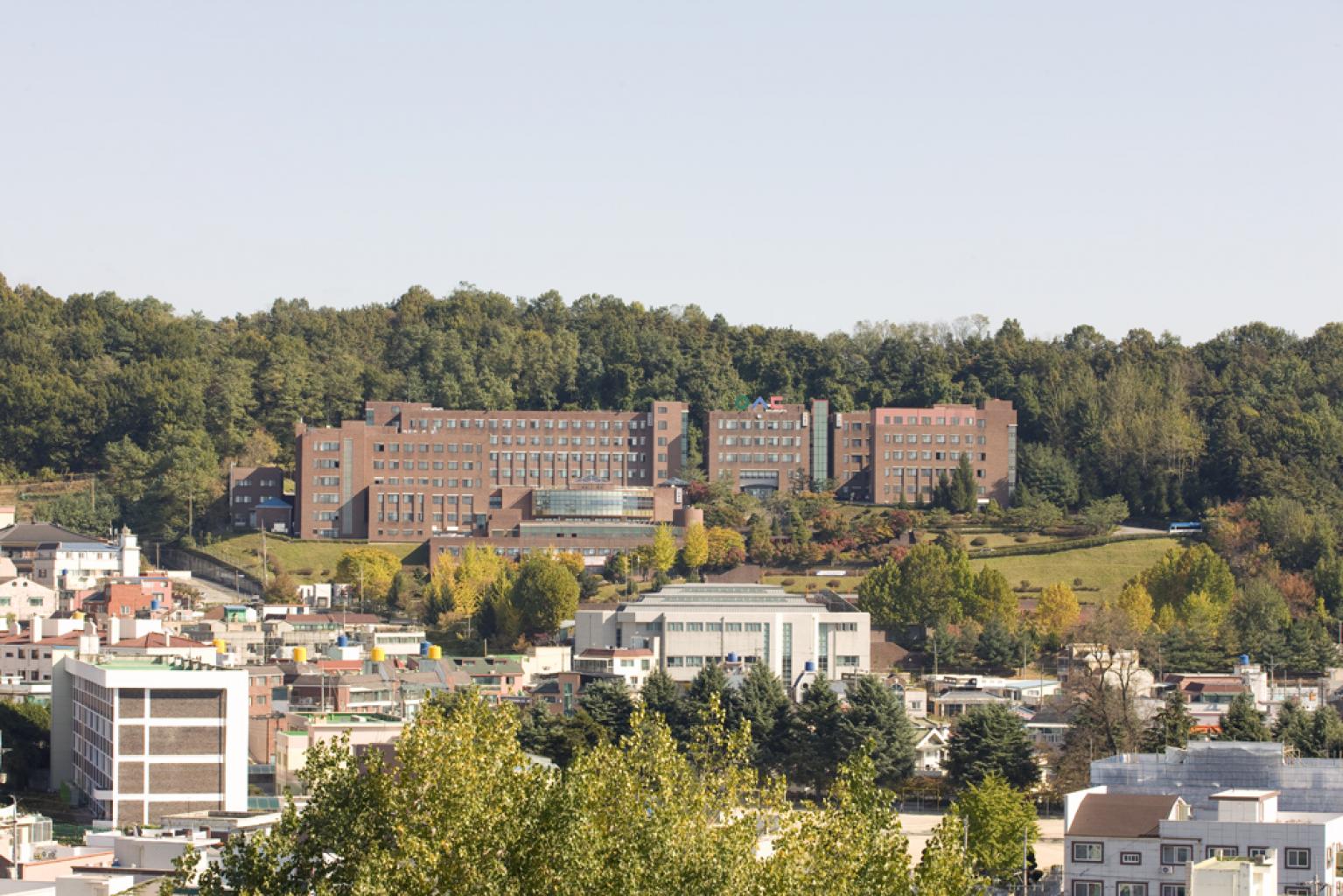
The university sits in Daejeon, a city of roughly 1.5 million people, and enrolls about 13,000 students across 802 full-time faculty, 246 of them foreign nationals. Its international body is drawn from 60 different nationalities, concentrated in English-track colleges such as SolBridge International School of Business, whose AACSB-accredited MBA alone counts students from 79 nationalities.
Apply here if a score-based interview process suits you better than a numbers-only cutoff, and if a fully English-taught degree at a mid-tier Korean university — rather than a flagship SNU- or KAIST-tier name — fits your plans. Business, culinary arts, hospitality, AI and design run the widest spread of programs; the $50 (bachelor/master) or $70 (PhD) application fee is non-refundable, so it's worth confirming eligibility before filing.
The tightest constraint isn't the interview score but the paperwork behind it: a bank balance statement and apostilled academic records, both of which take weeks to arrange from overseas and are worth starting before the interview is even scheduled.
47
Programs
9 phd, 15 master, 19 bachelor
USD 10,729
Avg. Tuition / Year
| Document | Bachelor | Master's | PhD |
|---|---|---|---|
| Passport copy | Required | Required | Required |
| Diploma and transcript (apostilled or consular-legalized) | Required | Required | Required |
| Language test score (IELTS/TOEFL or TOPIK) | Required | Required | Required |
| Family relationship certificate + parental ID copies | Required | Not required | Not required |
| Bank balance statement (USD 16,000) | Required | Not listed* | Not listed* |
| Research proposal | Not required | Required | Required (designated form) |
| Employment certificate | Not required | Sometimes (if applicable) | Not required |
*The bank balance statement isn't on the graduate admission checklist, but the same $16,000 figure resurfaces at the visa stage for every degree level — see Visa & Work Rights below.
| Intake | Applications open | Deadline | Notification | Semester starts |
|---|---|---|---|---|
| Fall 2026 — undergraduate, within Korea | Mar 2, 2026 | Jul 31, 2026 | Aug 7, 2026 | Sep 1, 2026 |
| Fall 2026 — undergraduate, outside Korea (closed) | Mar 2, 2026 | Jul 10, 2026 | Aug 7, 2026 | Sep 1, 2026 |
| Fall 2026 — master's/PhD (rolling) | May 2026 | Aug 2026 | — | Sep 1, 2026 |
| Spring 2027 — outside Korea | — | Jan 16, 2027 | — | Mar 2, 2027 |
| Spring 2027 — within Korea | — | Jan 30, 2027 | — | Mar 2, 2027 |
| Fall 2027 (per catalog) | — | Jul 8, 2027 | — | Sep 1, 2027 |
The interview carries as much weight as the paperwork, not less: it's worth 100 of 200 points at graduate level, and at undergraduate level it sits alongside documents as the deciding factor rather than a formality after them. English-track applicants should prepare to talk through why they chose their major, not just present a test score and wait.
The bank-balance statement and apostilled academic records are the most common bottleneck, and both can take weeks to arrange from overseas — start them before scheduling the interview rather than after receiving a conditional offer.
Scholarship bands are keyed to the English-test score actually on file at the time of application, not a separate scholarship exam. Clearing the next IELTS or TOEFL band before applying is worth 5 to 40 percentage points of tuition, so a resit before filing can be worth more than a stronger essay.
Graduate applicants know exactly what their 200 points cover before they walk in: the document half splits into 50 points for GPA and 50 for the research proposal, while the interview half weighs 60 points on depth of subject knowledge, 30 on general academic capability, and 10 on relevant work experience already on the CV. Undergraduate applicants are scored out of 100 the same way — academic attitude, academic capability and language proficiency, and fit for the intended major — averaged across two separate interviewers rather than decided by one.
SolBridge International School of Business runs the university's most selective and highest-priced track: its AACSB accreditation covers both the Business Administration bachelor's degree and the MBA, and the university describes the MBA as the only fully English-taught MBA in the country, with students from 79 nationalities and faculty from 15 countries.
Before you submit
Get your Woosong University application checked by an advisor
One missed document can cost you a whole intake. Spend 30 minutes with an advisor who has taken students through this exact application, and leave knowing what to submit , and what has to happen before 8 July 2027.
30 minutes · one-to-one
| Level | Annual tuition (USD) | Range example |
|---|---|---|
| Associate (2-year) | $5,706 – $7,754 | K-Beauty Makeup / K-Pop Music and Dance to Baking and Pastry / Culinary Arts |
| Bachelor | $3,840 – $12,592 | IDegree (online-only, first 4 semesters) to AACSB Business Administration |
| Master's | $7,014 – $28,164 | Global and Human Studies to the AACSB MBA |
| PhD | $9,750 – $14,082 | Hospitality/Tourism and Management Studies tracks to Global Management |
| Item | Cost |
|---|---|
| Enrollment fee (one-time) | $169 (associate) / $650 (bachelor) / $825 (master's/PhD) |
| Room & Board (1 meal/day, extra meals $4 each) | $2,352/year; $340/semester for summer or winter intersession |
| University-arranged insurance | $100/year (undergrad) / $110/year (grad) |
| Student Council + remittance fees | $56 + $40/year (undergrad) / $40/year (grad) |
| Optional departmental activity fee | ~$300/year — recommended, since it gates department activities |
| Estimated extras beyond tuition | $3,417/year (undergrad) / $3,447/year (grad) |
Last verified July 20, 2026, against Woosong's own Tuition & Fees page.
All fees are capped at a maximum 5% year-to-year increase, so a quoted first-year figure is a reasonable guide to what later years will cost. The AACSB MBA sits well above every other program on the list — at $28,164/year it costs roughly four times the cheapest master's track, Global and Human Studies at $7,014. Bachelor's tuition spreads more evenly, from $3,840 for the online-first IDegree track's first four semesters up to $12,592 for the AACSB Business Administration degree, with most other bachelor's programs sitting well below that ceiling.
Health cover changes partway through a student's stay: university-arranged insurance covers roughly the first six months at $100/year (undergrad) or $110/year (grad) on the tuition invoice, after which enrollment in Korean National Health Insurance becomes mandatory at roughly $600/year. Payment can be made at a KEB Hana Bank branch, by virtual-account transfer from any bank, or by overseas remittance to the university's account — the remittance note must carry the student's name and application number.
South Korea draws no EU/EEA-versus-everyone-else line here: the tuition schedule and the D-2/D-4 visa track apply identically to every non-Korean nationality. The one nationality-specific rule on file is procedural rather than financial — Chinese citizens applying to the Korean track file a paper application instead of the online form.
| Scholarship | Who's eligible | Amount | Coverage |
|---|---|---|---|
| English-track admission scholarship | IELTS 5.5–7.5+ or TOEFL iBT 46–101+ on file at application | 30–70% tuition, plus 5–10% for a strong interview | First semester |
| SolBridge/JCFS admission scholarship | IELTS 5.5–8.0+ on file at application | 30–80% tuition, plus 5–15% for a strong interview | First semester |
| Korean-track admission scholarship | TOPIK Level 3–6 | 30–100% (TOPIK 6 waives all four years, if GPA stays at 3.75+ every semester) | First semester (TOPIK 6 continues) |
| Merit scholarship | 15+ credit hours completed (bachelor) or 9–12 (master's/PhD/MBA), no F grades | 30–100% (undergrad) / 20–30% (grad) | From the second semester onward |
| Transfer scholarship | General transfer students | Flat 30% | — |
| Academic Excellence Scholarship (graduate) | GPA 3.50+ in the 3rd/4th undergraduate year | 50% (general schools) / 30% (special graduate schools) | — |
| International Students Special Scholarship (graduate) | New international graduate students | 30% first semester, then performance-based | — |
| Research Support Scholarship (graduate) | Research-track graduate students | Full tuition | — |
| Alumni enrollment-fee waiver | Woosong graduates continuing at the university | Enrollment fee waived | — |
Every admission scholarship covers tuition only, for the first semester; from the second semester, renewal runs automatically through the Merit Scholarship track once the credit-hour and GPA conditions are met. That renewal needs at least 15 credit hours completed the prior semester for undergraduates, or 9 for master's/PhD students (12 for MBA), with no F grades, calculated from whichever is higher between semester GPA and cumulative GPA.
Because the English- and Korean-track bands are keyed to the exact test score on file when you apply, not a separate scholarship exam, the single highest-leverage move before submitting an application is clearing the next IELTS, TOEFL or TOPIK band — each step up is worth 5 to 10 percentage points on its own, before the interview bonus is even added. SolBridge and JCFS run a steeper scale than the rest of the university: an IELTS 8.0+ score there is worth up to 80% of tuition, against a 70% ceiling on the general English-track scale. Graduate students who take on department or administrative assistant duties can also draw the separate Administrative Assistant Scholarship on top of the awards above.
| Level | Programs in our catalog | Language |
|---|---|---|
| Associate / non-degree | 4 | English |
| Bachelor | 19 | English |
| Master's | 15 | English |
| PhD | 9 | English |
Every one of the 47 programs indexed in our catalog is taught in English; Woosong's own program pages describe more than 20 degree programs as 100% English-taught at bachelor, master's and PhD level, alongside 60-plus Korean-taught programs the catalog doesn't cover. Management is the largest single discipline cluster (19 catalogued rows), followed by Artificial Intelligence (4).
The flagship English-track colleges are SolBridge International School of Business (BBA, MBA, MS and Digital MBA, AACSB-accredited), Endicott College of International Studies (AI Management, AI and Big Data, Global Hospitality), the College of Culinary Arts (Global Culinary Arts, Global Restaurant Management), and JW Kim College of Future Studies (Human and Digital Interface/AI-HCI, Data Science, and the online-first IDegree program). Doctoral study runs through tracks such as the PhD in Global Management, alongside hospitality, IT management and design management PhDs.
The bachelor's slate splits between business-adjacent management degrees and hands-on practical tracks: culinary arts, K-Pop performance and management, and K-Beauty design each run their own dedicated bachelor's or associate program rather than sitting inside a general arts degree, alongside the AI and digital-interface tracks under Endicott and JW Kim College.
Woosong University
Woosong University
Woosong University
Woosong University
Woosong University
Woosong University
Woosong University
Woosong University
Woosong University
Woosong University
International students live in one of two dedicated dormitories: the International Dormitory on West Campus (undergraduate, double rooms, on-site gym and cafeteria) or Sol-Geo on East Campus, which encourages mixed-nationality roommates in the first year and adds a library, dance studio and two cafeterias to 2–4 person rooms. The official Room & Board line item is $2,352/year for one meal a day (extra meals $4 each), or $340/semester for a summer or winter intersession stay.
The international body spans 60 nationalities campus-wide, concentrated further in tracks like the SolBridge MBA, whose cohort alone draws from 79 nationalities — itself taught by faculty from 15 countries. Students who'd rather live off campus go through roughly five foreign-language-capable real estate agencies coordinated by the university's International Student Support Team; the local convention is a deposit plus monthly rent, with a customary 10% down payment to hold a unit, arranged in the Korean lease style rather than the pay-monthly system many international students expect from home.
Part-time work is capped at 20 hours a week for bachelor's and language-track students, or 30 hours a week for master's and PhD students, with extra hours possible for a TOPIK Level 5+ score or an 'A' grade the previous semester. No work is allowed during a student's first semester, and both the university's international office and the Korean Immigration Office have to approve it before anyone starts.
Daejeon, South Korea's fifth-largest city at roughly 1.5 million people, puts Daejeon Station — on the KTX high-speed line — a 20-minute walk from campus, with the Daejeon Complex Bus Terminal another 20–30 minutes out.
The clearest outcomes signal Woosong publishes is accreditation, not a placement statistic: both the Business Administration bachelor's degree and the MBA carry AACSB accreditation through SolBridge International School of Business, the credential employers in international business recognize regardless of where a graduate ends up working. That accreditation puts the business track on a different footing from the rest of the English-taught catalog, where no equivalent professional accreditation is cited.
Graduate students can also earn while studying without touching their work-hour cap: the Graduate School's in-school work-scholarship program pays for on-campus assistant and research roles, and because that work is credit-linked coursework rather than outside employment, it needs no separate Immigration Office application. The same logic covers library jobs, teaching-assistant roles, and curriculum-linked research or internships — all exempt from the work-permit process that applies to outside part-time jobs, which does require dual approval from the university and Immigration Office before it starts.
On the visa side, a D-2 (degree) registration runs up to two years per issuance, cycling through D-2-1 for associate study up to D-2-4 for PhD study, with D-2-7 covering research students. Once that period or the degree itself runs out, the standard route is a status-change application filed at the local Immigration Office rather than a fresh visa application submitted from outside the country entirely — a distinction worth knowing well before a first D-2 registration nears its renewal date.
Every non-Korean nationality goes through the same visa system — Korea draws no EU/EEA-versus-everyone-else line the way European destinations do. Degree students hold a D-2 visa (D-2-1 associate, D-2-2 bachelor, D-2-3 master's, D-2-4 PhD); non-degree and language-track students hold a D-4. The one nationality-specific rule on file is procedural: Chinese citizens applying to the Korean track submit a paper application rather than the online form.
Visa application fees run about $40 for a single-entry visa valid 90 days or less, $60 for one valid longer than 90 days, $70 for a double-entry visa, or $90 for an unlimited-entry visa. Financial proof for the visa itself is the same bank balance statement used at admission: at least $16,000 in the applicant's or a parent's name, or in the applicant's own Korean account if already resident.
After arriving, an Alien Registration Card is required within 90 days; filing costs 30,000 KRW individually or 40,000 KRW through the university's batch application service, which trades a small fee premium for the university handling the paperwork, and takes about 2–3 weeks to process either way. Any change of residential address afterward has to be reported within 14 days, a rule that catches students who move between the dormitory and an off-campus lease mid-year.
Part-time work needs approval from both the university's international office and the Immigration Office before it starts — up to 20 hours a week for bachelor's and language-track students, or 30 for master's and PhD students, with none allowed in the first semester. Working without that dual approval risks fines starting at 1,000,000 KRW, plus visa cancellation or deportation for a repeat offense. Health cover starts with university-arranged insurance (about $100–110/year on the tuition invoice) for roughly the first six months, after which enrollment in Korean National Health Insurance becomes mandatory at around $600/year.
Browse programs, compare universities, and start your application.
Applying to Woosong University?
Get your application reviewed 1:1
We use cookies to improve your experience and analyze traffic. Read our Cookie Policy .